🌌 Introduction
For decades, space exploration was dominated by government agencies like NASA and Roscosmos. But in 2025, a new chapter has begun — one driven by innovation, competition, and private ambition. The new space race isn’t just about reaching orbit; it’s about building a sustainable presence beyond Earth.
🚀 The Rise of Private Space Companies
Private companies have revolutionized the aerospace industry by reducing costs and accelerating innovation.
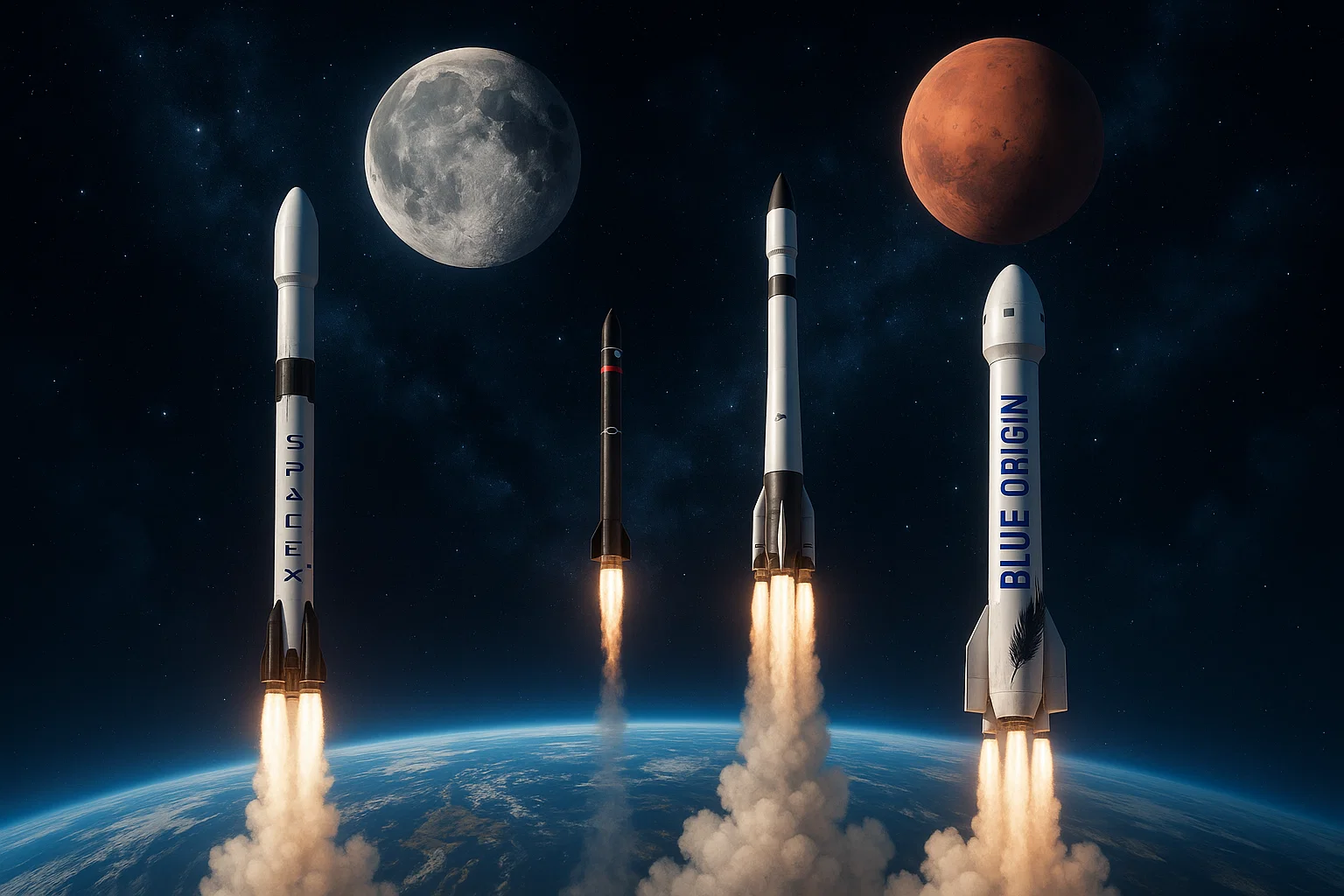
- SpaceX continues to lead with its reusable rockets and Starship program, aiming for Mars missions by the end of the decade.
- Blue Origin, founded by Jeff Bezos, is developing the New Glenn rocket and building infrastructure for future space habitats.
- Rocket Lab focuses on smaller satellite launches, helping startups and researchers access orbit affordably.
These companies represent a shift from government-funded exploration to commercial space innovation.
🪐 Moon Missions: A Stepping Stone to Mars
NASA’s Artemis Program collaborates with SpaceX and other private partners to return humans to the Moon. The Moon will serve as both a launch base and testbed for deep-space technologies.
Private companies are also planning lunar mining operations, targeting water ice and rare minerals to support long-term missions.
Key takeaway: The Moon is no longer just a destination — it’s the gateway to Mars and beyond.
🌠 The Role of Space Tourism
Space tourism, once a fantasy, is becoming reality. Companies like:
- Virgin Galactic offer suborbital flights for civilian passengers, and
- SpaceX’s Starship is preparing to send private crews around the Moon.
While still expensive, these ventures are expected to lower costs and inspire a new generation of space enthusiasts.
🛰️ Satellites, Data, and the Space Economy
The space economy is now valued at over $500 billion, with massive growth expected by 2030.
Low-Earth-orbit (LEO) satellites, such as Starlink and OneWeb, provide global internet coverage and drive data-based innovation in climate monitoring, navigation, and security.
This surge in private satellite networks highlights how space exploration and global connectivity are becoming intertwined.
🌍 Challenges Ahead
Despite progress, private space exploration faces major challenges:
- Space debris management and orbital congestion
- International regulations for resource ownership and safety
- Environmental impact of rocket launches
Balancing innovation with sustainability will determine whether the new space age remains open and accessible for all.
🌌 Conclusion
The new space race isn’t about politics — it’s about possibility. Private companies are transforming how humanity reaches for the stars, making space exploration faster, cheaper, and more collaborative than ever before.
As 2025 unfolds, one thing is clear: the future of space belongs to both pioneers and dreamers.


